

Pioneering recipe for conductive plastics paves way for human bodies to go online
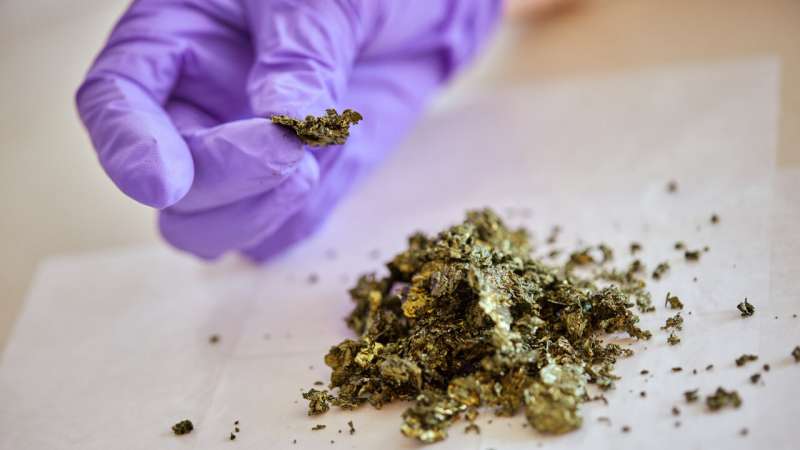
It’s moldable, biocompatible and glitters like gold. Plastic that can conduct an electric charge is a material that can be used for everything from sensors that can monitor our health to self-cooling clothing or electronic adhesive plasters that can be applied to the skin and send data directly to a mobile phone.
Researchers at Chalmers University of Technology in Sweden recently presented a “recipe” that makes it easier to manufacture this kind of sought-after electrically conductive plastic in larger quantities—without the use of harmful chemicals, and in a much more cost-effective way.
“Once higher production volumes are achieved, it is possible to work with the material in a completely different way. Larger quantities are needed to enable the development of a range of applications, for example in biotechnology, energy storage, and wearable electronics,” says Christian Müller, Professor at the Department of Chemistry and Chemical Engineering at Chalmers and co-author of a study published in Science Advances.
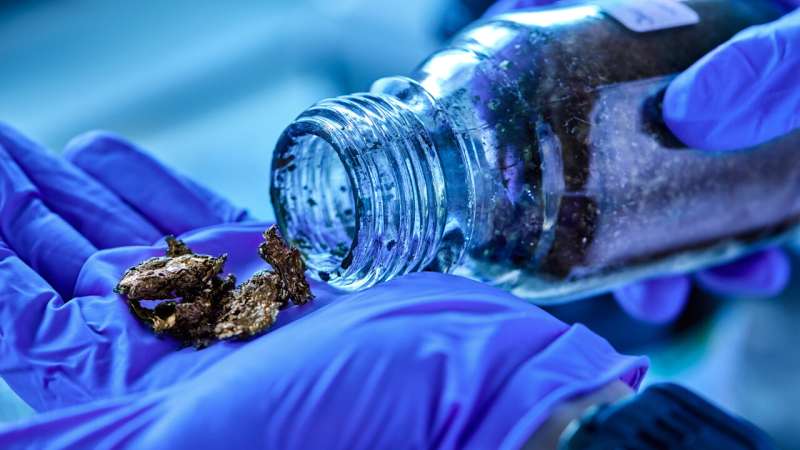
In the lab in the Chemistry building at Chalmers, doctoral student Joost Kimpel shows how this glittering, gold-colored material can be easily molded with his gloved fingers.
Currently, the market price for just 100 grams of this type of conductive plastic would be around USD 100,000—about ten times as much as actual gold. But for the human body, it is in fact the absence of metals that makes this material so valuable.
“While some metals can corrode in humid environments, conductive plastic is an organic material that our bodies are comfortable with. The material is compatible with the body’s own tissue, while also being a semiconductor. There’s also an environmental advantage in that you don’t need to use the rare earth elements required for today’s electronics,” says Kimpel, first author of the new study.
Electronic adhesive plasters with connectivity
There is great interest in conductive plastics, or conjugated polymers, which is the scientific term for them, and the applications are many—not least in biotechnology.
According to the researchers, these applications could include sensors that monitor medical conditions, provide information about fitness and health, or adjust the delivery of drugs for diseases that are difficult to treat. With this kind of technology, the body can be connected to other wearable electronics, and even to our mobile phones.
Conductive plastics can also be used for various kinds of implants or be 3D-printed to create electronic adhesive plasters that can detect an infection, for example.
Research into conductive plastics is being carried out in many parts of the world. Müller’s research group has been exploring this type of material for more than a decade, and has made several important advances in the field.
Unexpected lab results behind the latest advance
The key to the new manufacturing method was discovered quite serendipitously—during a routine experiment in the lab. When a chemical reaction was happening too fast and the resulting plastic was reaching its final state too quickly, the idea came up of reducing the heat in the process.
This was what led to the discovery that you can produce this material at room temperature—involving significantly fewer steps, with lower energy consumption, and without toxic chemicals.
“The ingredients in our ‘recipe’ are benign and can be used safely in an industrial setting, unlike the highly toxic substances that must be used to produce many conjugated polymers today. Avoiding toxic chemicals in the production process means a safer work environment for staff, gives the consumer peace of mind, and facilitates recycling. In addition, the costs can be radically reduced, as toxic substances require advanced handling, especially in terms of protective procedures, storage and the disposal of residues,” says Kimpel.
Great interest in the new method
Even though the study was published very recently, the researchers have already noted a great deal of interest, not least from the many researchers at other universities who have contacted them. Now they hope that this new production method will facilitate making conductive plastics more widely available.
“An important discovery made in this study is that the production method makes the conductive plastic much better at conducting an electric charge, which also means that the electronics that use this kind of material can be made more powerful,” says Müller.
The next step in this research will be to continue working on a method that makes it possible to produce even larger volumes—continuously and with exactly the same results every time.
“The possibilities are great, but it’s ultimately up to society and the market to decide what will be developed. It’s a big step from the lab to industrial-scale production, but we hope that this new production method will be of benefit,” says Müller.
How this electrically conductive plastic is produced
The basic ingredients originate from the aromatic compounds thienothiophene and bithiophene, which are the basic building blocks of many organic semiconductors. These substances are mixed in the benign solvent N-butyl-2-pyrrolidone in the presence of a palladium catalyst.
Almost immediately, the transparent solution begins to change color as the building blocks start to assemble into polymer chains. These larger and longer molecules form the basis of the conductive plastic.
Once the color has changed from yellow to deep red and then to deep purple, the reaction is complete. The mixture is then washed using several different solvents to remove impurities. Finally, the solvents are removed using rotary evaporation—a method similar to distillation.
After the separation process, a glittering gold-colored substance remains, the color being an indication that the material is electrically conductive. The production of the conductive plastic is now complete.
More information:
Joost Kimpel et al, Open-flask, ambient temperature direct arylation synthesis of mixed ionic-electronic conductors, Science Advances (2025). DOI: 10.1126/sciadv.adv8168
Chalmers University of Technology
Citation:
Pioneering recipe for conductive plastics paves way for human bodies to go online (2025, September 18)
retrieved 19 September 2025
from https://techxplore.com/news/2025-09-recipe-plastics-paves-human-bodies.html
This document is subject to copyright. Apart from any fair dealing for the purpose of private study or research, no
part may be reproduced without the written permission. The content is provided for information purposes only.
Comments are closed