
Cotton-based methanol fuel cells could power future flexible electronics
Cotton-based fiber fuel cells can now convert methanol into electricity while sustaining peak power density through 2,000 continuous flex cycles. This breakthrough paves the way for safe, high-performance power sources for flexible electronics and wearable devices.
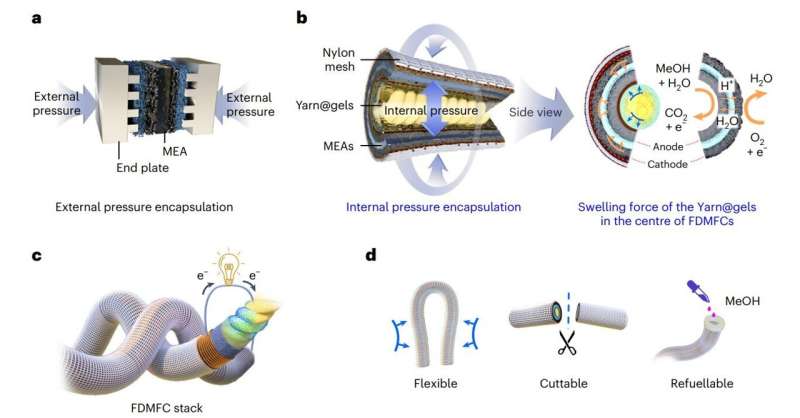
Researchers at Soochow University developed fiber-shaped direct methanol fuel cells (FDMFCs) using gel-encapsulated woven yarns. These “Yarn@gels” employ an adaptive internal pressure strategy, where the natural swelling of cotton fibers within the gel matrix generates pressure to keep the cell components tightly bound, removing the need for bulky, rigid parts. The result is a fuel cell that is flexible, cuttable, water-resistant, and quick to refuel in just one minute.
The findings of this study are published in Nature Materials.
As personal technology evolves toward bendable wearable devices, the demand for flexible, lightweight power sources has ramped up dramatically. Scientists have designed flexible power sources of all sorts, from solar cells to lithium-ion batteries to supercapacitors. Yet each falls short, limited by light dependence, poor energy storage, and slow recharging, pushing researchers to seek out better power systems.
Fuel cells have emerged as promising players in this arena, offering high energy density and quick refueling that make them ideal for continuous use, but they also are not without their share of flaws. In this study, researchers addressed these challenges by introducing Yarn@gels into flexible fuel cell design. This innovation provided superior fuel retention and mechanical stability, but conquered the rigidity and sealing issues that had long plagued flexible fuel cells.
The design of the fiber-shaped methanol fuel cells began with preparing a primary gel from poly(N, N-dimethylacetamide) (PDMA) through UV-induced photopolymerization, using a cross-linker and a photoinitiator to form the gel matrix. To create the Yarn@gels, woven cotton yarn was soaked in this solution until fully saturated and then cured under UV light to form gel-coated fibers. The membrane electrode assembly (MEA) was prepared separately by spraying anode and cathode catalyst inks onto a pretreated Nafion membrane.
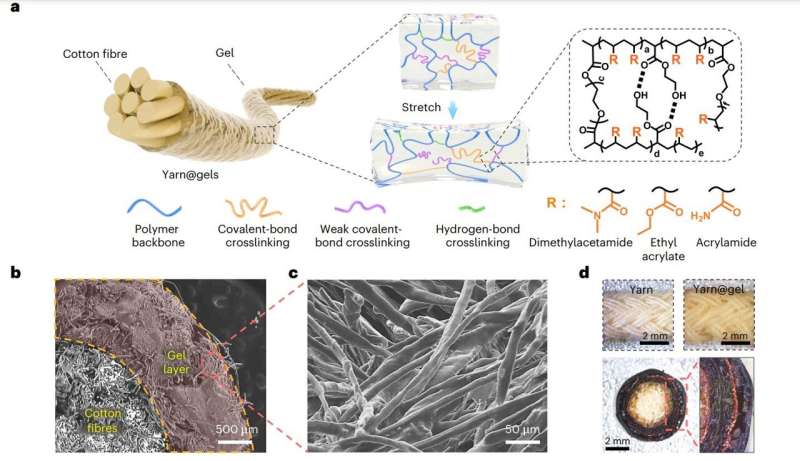
Finally, the fuel cells were constructed by wrapping multiple functional layers around the Yarn@gels core in a layer-by-layer fashion. The team then tested the electrochemical performance and mechanical limits of the fuel cells.
The fuel cells achieved peak power densities of 27.3 mW/cm² at 60 °C and 5.89 mW/cm² even below freezing, performing reliably from −22 °C to 70 °C. They retained 94.7% even after 1,500 cycles of 180° bending and continued to function with little performance loss even when cut in half. Even after 100 refuel–discharge cycles at 200 mA, no voltage drop was observed.
The exceptional resilience and power performance of these fiber-shaped fuel cells make them ideal candidates for wearable electronics. The researchers note that this modular design could be scaled from smart textiles and wearable electronics to large-scale energy applications.
Written for you by our author Sanjukta Mondal, edited by Gaby Clark, and fact-checked and reviewed by Robert Egan—this article is the result of careful human work. We rely on readers like you to keep independent science journalism alive.
If this reporting matters to you,
please consider a donation (especially monthly).
You’ll get an ad-free account as a thank-you.
More information:
Yongjiang Yuan et al, Flexible fibre-shaped fuel cells with gel-mediated internal pressure encapsulation, Nature Materials (2025). DOI: 10.1038/s41563-025-02319-2
© 2025 Science X Network
Citation:
Cotton-based methanol fuel cells could power future flexible electronics (2025, September 17)
retrieved 18 September 2025
from https://techxplore.com/news/2025-09-cotton-based-methanol-fuel-cells.html
This document is subject to copyright. Apart from any fair dealing for the purpose of private study or research, no
part may be reproduced without the written permission. The content is provided for information purposes only.
Comments are closed