

The lord of the ring mouse—a lightweight, ring-based computer mouse lasts over a month on a single charge
As the use of wearable devices such as augmented reality (AR) glasses has slowly but steadily increased, so too has the desire to control these devices in an easy and convenient way. Ring controllers worn on the finger already exist, but usually have some drawbacks in their size, weight or power consumption. Researchers, including those at the University of Tokyo, developed picoRing, an ultralow-power, ring-based wireless mouse to solve this problem. It uses a novel method to communicate with devices, giving it an incredibly long use period between charges.
The humble computer mouse has been around for a long time. They are so established that various attempts to shift the paradigm of the way we input movement to devices have failed to take hold. One reason for this being that something needs to be incredibly intuitive and even more convenient than current mice already are.
To this end, wearable, ring-based devices have already been brought to market, but they have not caught on in a significant way, often due to technological limitations. But as some use cases become more common, especially those that require or benefit from desk-free and hands-free use, rings are a strong candidate to pull people away from their beloved mice.
The study is published as part of the Proceedings of the 38th Annual ACM Symposium on User Interface Software and Technology.
“My team and I created picoRing, an ultralow-power, tiny mouse that controls AR glasses for over a month on a single charge. Previous so-called smart rings suffer from short lifespans because their small 50–60 megawatt-hour batteries struggle to power the necessary communications components for long,” said Project Assistant Professor Ryo Takahashi from the University of Tokyo’s Department of Electrical Engineering and Information Systems.
“To solve this challenge, we needed picoRing to use hundreds of times less power at around 30–500 microwatts. So, we introduced a watchlike wristband that acts as a signal relay between the ring and AR glasses or other devices. This allowed us to use far weaker, and less power-hungry, communications components in the ring itself.”
-
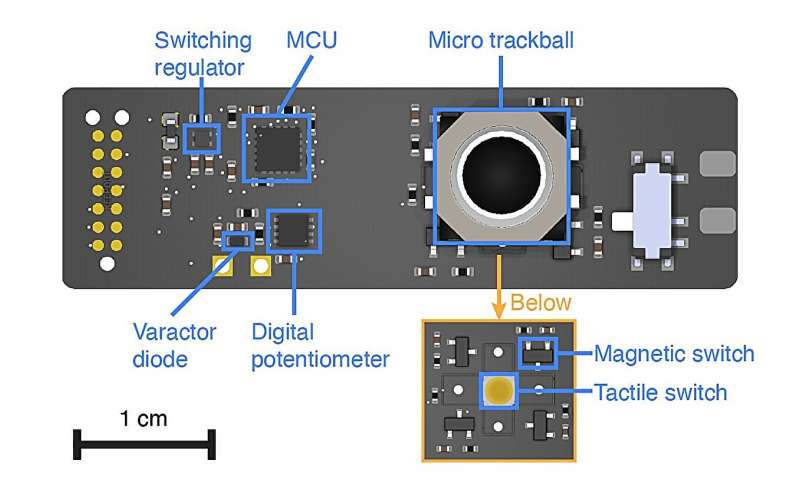
Inside the picoRing. A diagram and teardown of the picoRing revealing the angled signal coils and electronic components placement. Credit: Proceedings of the 38th Annual ACM Symposium on User Interface Software and Technology (2025). DOI: 10.1145/3746059.3747615
-
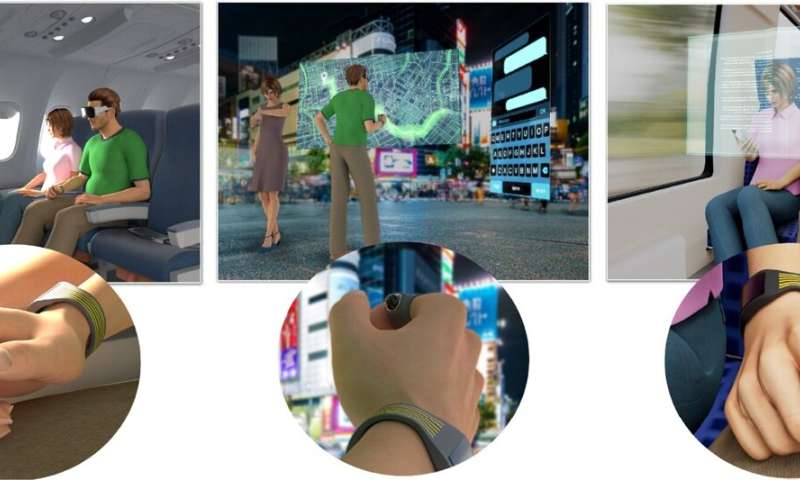
picoRing use cases. Credit: Proceedings of the 38th Annual ACM Symposium on User Interface Software and Technology (2025). DOI: 10.1145/3746059.3747615
-
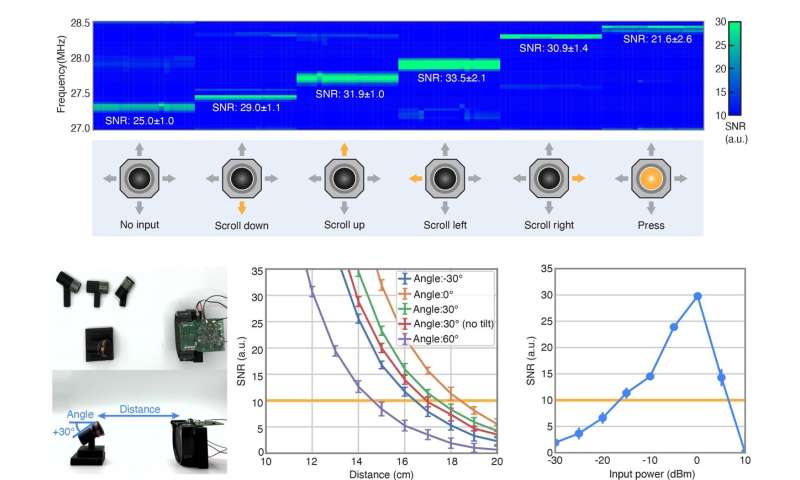
picoRing signals. The different scroll directions and button push send signals of different frequencies for the wristband to interpret and pass to the device. The angle of the ring also affects the signal-to-noise ratio. Careful engineering of the signal coils optimizes for the most natural angle it takes on your finger. Credit: Proceedings of the 38th Annual ACM Symposium on User Interface Software and Technology (2025). DOI: 10.1145/3746059.3747615
Bluetooth, while power-efficient in the context of some devices, would use too much power for the researchers’ purpose, and NFC, which is fully passive, doesn’t need any local power source at all, but only works at very small distances.
So Takahashi and his team had to innovate and come up with something based on semi-passive inductive telemetry (semi-PIT). This uses a familiar coil of wire used to send or receive signals, but incorporates distributed capacitors throughout its length. This special arrangement acts to amplify magnetic fields used for communication, effectively giving them a free power boost without needing an active signal amplifier. The ring only weighs 5 grams.
“Although it’s just a prototype, picoRing could have several useful impacts on the way people interact with technology. Obviously, it could mean longer-lasting wearable technology becomes more common, but it also offers a new intuitive way to interact with AR,” said Takahashi.
“It offers more discreet control to avoid being too obvious in public spaces, is generally more convenient because it’s so compact, and may become a platform for health sensors or other innovations. The limitations at present are common to prototype devices; it’s still relatively bulky for a ring, suffers from some interference and can only transfer quite simple information. Scrolling and pressing are OK, but complex hand gestures aren’t possible yet.”
So, there’s still some way to go before you pop one of these on your finger. The team intends to improve comfort, make the system more reliable in busy wireless environments, and test it in more practical scenarios, such as long sessions or special use cases. The wristband might also be a bit of a hurdle, but it’s necessary as it provides a wireless relay link between the ring and the device. Potential improvements in other related fields, like electronic textiles, could help here and might boost the functionality of the ring along with it.
“Our technology could be adapted for health monitoring. A ring is in close contact with the skin, which makes it a good place to measure signals like heart rate or stress-related changes. Combining these health features with interaction control could open the door to multifunctional wearable devices,” said Takahashi.
“At this stage, though, picoRing is best suited for AR and VR (virtual reality) environments, where traditional mice are awkward to use. For typical office work like spreadsheets or long editing sessions, a standard mouse is still more comfortable. But as the technology improves, it could become a lightweight alternative for mobile or occasional use.”
More information:
Yifan Li et al, Ultra-low-power ring-based wireless tinymouse, Proceedings of the 38th Annual ACM Symposium on User Interface Software and Technology (2025). DOI: 10.1145/3746059.3747615
University of Tokyo
Citation:
The lord of the ring mouse—a lightweight, ring-based computer mouse lasts over a month on a single charge (2025, October 6)
retrieved 7 October 2025
from https://techxplore.com/news/2025-10-lord-mouse-lightweight-based-month.html
This document is subject to copyright. Apart from any fair dealing for the purpose of private study or research, no
part may be reproduced without the written permission. The content is provided for information purposes only.
Comments are closed