
Artificial neurons become more advanced—and simpler—with conductive plastics
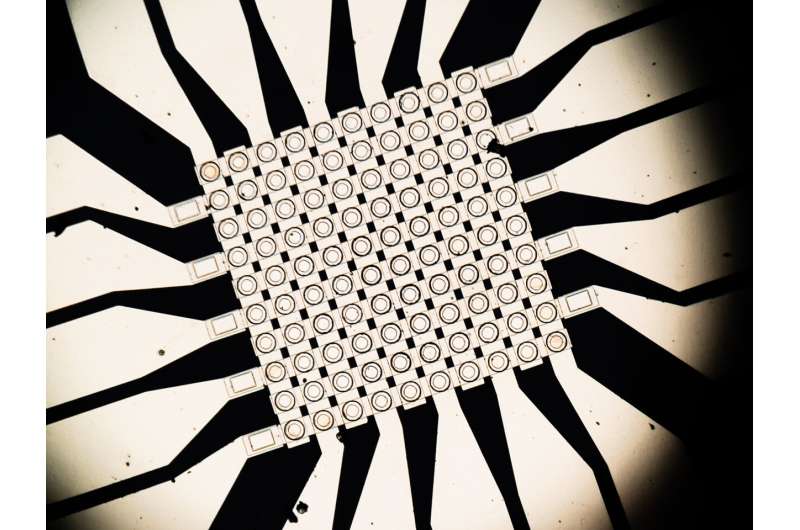
An artificial neuron made of conductive plastics that can perform advanced functions similar to those of biological nerve cells has been demonstrated by researchers at Linköping University, Sweden. The results, published in Science Advances, pave the way for a new generation of body‐integrated sensors, medical implants, and robotics.
“Mimicking the behavior of biological neurons has long been a major goal in so‐called neuromorphic engineering. Traditional silicon‐based electronics fall short because they don’t speak the same language as the nerve cells in our body,” says Simone Fabiano, professor of materials science at Linköping University, LiU.
Instead of relying on rigid silicon, Fabiano’s team at the Laboratory of Organic Electronics at LiU works with a class of soft, flexible materials called conjugated polymers that can transport both ions and electrons. This dual capability allows them to interface more closely with biological systems.
In their article, Fabiano’s research group has shown that their artificial neurons can perform a type of information processing observed in our nervous system. This function means the neuron activates only when one input is present and another is absent. It is called anticoincidence detection and is a core principle in tasks like tactile sensing.
“We can imagine using these devices to add a sense of touch in prosthetics or robotics. They show that organic electronics are not just softer alternatives to silicon, but can enable new kinds of neural computing that connect biology with electronics,” says Fabiano.
-
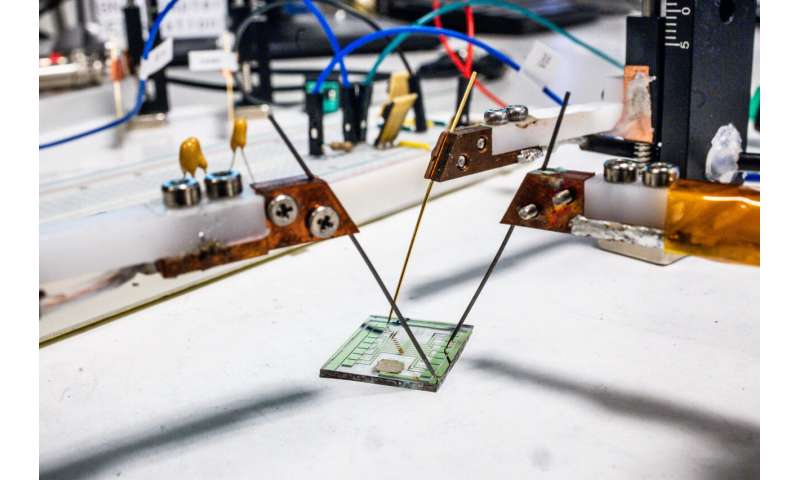
Researches at Linköping University have created artificial neurons can perform a type of information processing called anticoincidence detection. Credit: Thor Balkhed
-
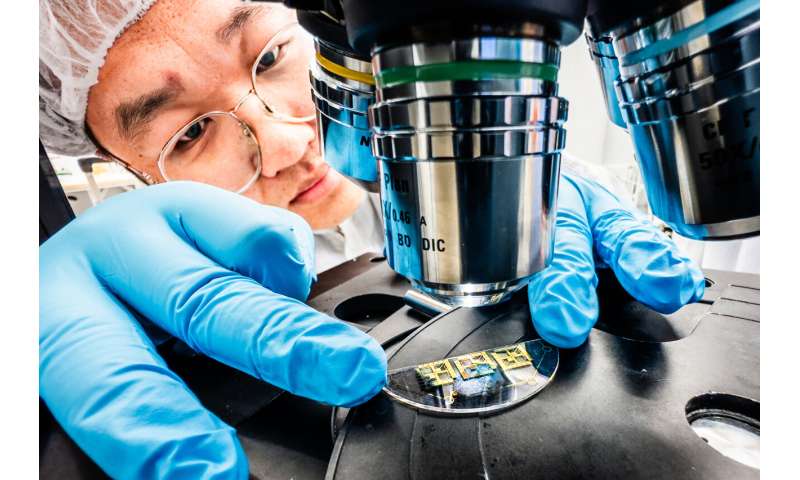
Junpeng Ji, researcher at the Laboratory of Organic Electronics at Linköping University. Credit: Thor Balkhed
In parallel with developing advanced functionality, his research group has also worked to simplify the basic structure of these artificial neurons.
In early 2023, the researchers at Campus Norrköping succeeded in creating artificial nerve cells that reproduced 15 of the 22 key properties of biological neurons. However, those plastic nerve cells relied on many different components, which limited their practical use.
Now, in a study published in Nature Communications, the team has further refined the technology. They have reduced the artificial nerve cell to just a single organic electrochemical transistor, while still reproducing as many as 17 neural properties. This artificial neuron is not only highly functional but also extremely compact, comparable in size to a human nerve cell.
“This is one of the simplest and most biologically relevant artificial neurons made to date. It opens the door to integrating synthetic neurons directly with living tissue or soft robots,” says Fabiano.
More information:
Padinhare Cholakkal Harikesh et al, Single organic electrochemical neuron capable of anticoincidence detection, Science Advances (2025). DOI: 10.1126/sciadv.adv3194
Junpeng Ji et al, Single-transistor organic electrochemical neurons, Nature Communications (2025). DOI: 10.1038/s41467-025-59587-4
Linköping University
Citation:
Artificial neurons become more advanced—and simpler—with conductive plastics (2025, September 17)
retrieved 18 September 2025
from https://techxplore.com/news/2025-09-artificial-neurons-advanced-simpler-plastics.html
This document is subject to copyright. Apart from any fair dealing for the purpose of private study or research, no
part may be reproduced without the written permission. The content is provided for information purposes only.
Comments are closed